
Double energy tax on your home battery: when do you pay twice?
Last updated 7 min read
What changed: New page.
From 2027 your home battery can cost you energy tax twice: when it feeds grid power back. When it does, when it does not, and what the cabinet is doing.
All articlesUp to and including 2026 a home battery does not cost you double energy tax: net metering offsets it. From 1 January 2027 it does, if your battery charges from the grid and feeds that power back later. If you use the stored power yourself, or charge from your own solar, you do not pay twice. There is no fix yet.
What changes, and when?
 Home battery
Double energy tax is tied to net metering. That scheme ends on 1 January 2027. What that means for your annual bill is in our article on the end of net metering.
| When | What |
|---|---|
| Up to and including 31 December 2026 | Net metering: what you feed back, you offset on your annual bill against what you draw, energy tax included. Double tax does not arise. |
| From 1 January 2027 | Net metering ends. You pay energy tax on all power you draw from the grid. For power you feed back you get a feed-in payment, without energy tax. |
| Now (October 2026) | The cabinet is looking into whether the double charge can be removed technically after 2026, together with the sector. Nothing has been decided. Before the end of 2026 the House of Representatives hears how the research is going. Whether a fix comes depends on what is technically possible and whether the benefits outweigh the costs. |
How does double energy tax arise?
The cabinet describes the route in four steps:
- Your battery charges power from the grid. You pay energy tax on that power.
- The battery stores the power.
- The battery feeds the power back to the grid. You get no energy tax back on it.
- Later you draw power from the grid again and pay energy tax again.
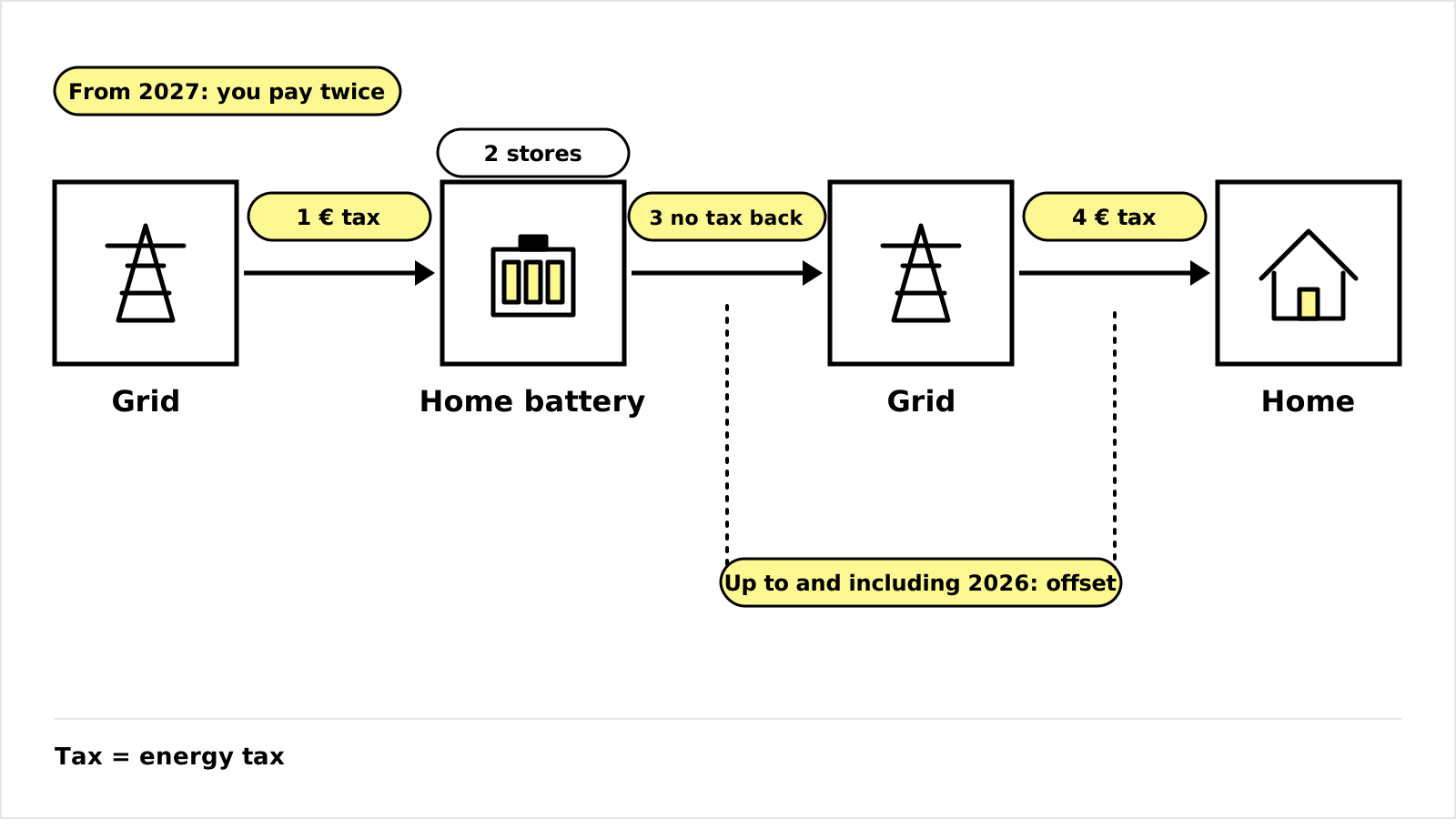
Up to and including 2026 that falls away, because step 3 is offset on your annual bill against step 4. From 2027 that no longer happens. The energy tax from step 1 is then lost to you.
When do you not pay twice?
Double energy tax does not apply by default to every battery. The cabinet names three situations in which you do not pay twice. The fourth row is the situation where it does happen.
| Situation | Up to and including 2026 | From 2027 |
|---|---|---|
| Own solar power → battery → use yourself | No energy tax | No energy tax |
| Grid power → battery → use yourself | Once, when drawn from the grid | Once, when drawn from the grid |
| Own solar power → battery → feed back | You pay no energy tax | You pay no energy tax |
| Grid power → battery → feed back → draw again later | Not twice, thanks to net metering | Twice: you do not get back the tax from the charging step |
Source: the cabinet's answer to parliamentary questions, 23 September 2026. See the list of sources below.
Not sure whether your battery feeds grid power back? Put your situation to us, and we will look at the steering that suits you.
What does it cost per kWh?
It concerns the energy tax on every kWh your battery charges from the grid and then feeds back:
- 2026: 9.161 cents per kWh, excluding VAT. Because of net metering you do not notice it now.
- 2027 (proposal): 8.80 cents per kWh, excluding VAT, for the first 10,000 kWh. Including VAT that is about 10.6 cents (our calculation: × 1.21). The 2027 Tax Plan is still with parliament.
Worked example (2027, proposal). Assumptions: your battery charges 500 kWh from the grid in a year, purely to feed it back later. We ignore losses when charging and discharging. On those 500 kWh you pay 500 × 8.80 cents = €44 energy tax when charging, excluding VAT. You do not get it back when feeding in. The price gap between charging and feeding back must first make up for that, plus the losses. Only then do you earn something.
This is not a forecast of your costs. How much your battery charges from the grid to feed back depends on your steering, your contract and your usage.
How to avoid double tax
- Let your battery work mainly for your own use. Grid power that you store and use yourself is taxed once. That is no different from having no battery.
- Charge with your own solar power where you can. You pay no energy tax on it, even if you feed it back later. No panels? Then read how it works with a home battery without solar panels.
- Look at the trading setting of your EMS (energy management system). Does the steering sell grid power back, for example on the hourly prices of a dynamic energy contract or through imbalance trading? Let that happen only when the price gap is larger than the energy tax and the losses. Ask your provider how the software weighs that.
- VAT reclaimed on your battery? Then you trade in power, and you reach this point first. Read VAT refund on a home battery as well.
What is the cabinet doing?
Position: no fix yet. The cabinet is researching and informs the House of Representatives before the end of 2026 about the progress.
- 2 July 2026: the House of Representatives adopts the Oosterhuis motion. It asks the cabinet to find out how double energy tax on storage can be prevented, and to inform the House before the end of the year.
- 23 September 2026: the cabinet acknowledges that the double tax can slow demand for home batteries. It is looking into the possibility of preventing double energy tax for home batteries and for bidirectional charging of cars.
- 8 October 2026: the 500-rules approach says that the ministries of Finance and Economic Affairs are working with the sector on a fix for the period after 2026. They weigh the administrative burden, whether it is workable for suppliers and the Tax Administration, and whether the Tax Administration can check it.
- 16 October 2026: the cabinet writes that Finance, Infrastructure and Water Management and Economic Affairs are jointly looking into whether the double tax can be removed technically, for example with smarter metering, and whether that is worth the extra complexity.
- Before the end of 2026: a progress report to the House. As soon as it is there, we update this page.
Our advice: plan with the rules as they are now, not with a fix that may come.
What does this mean for your situation?
Want to know what a home battery earns you after 2026, with or without trading? Book an advice call. Or first have a look at our home batteries.
Read more
- When double energy tax arises and when it does not: House of Representatives, answer to parliamentary questions on bidirectional charging (Appendix to the Proceedings II, no. 96, 23 September 2026) (Dutch)
- Energy tax from 1 January 2027 and feeding back: Tax Administration, Home battery and VAT (Dutch)
- Fix for double energy tax after 2026: House of Representatives, letter on the 500-rules approach with annex, point 13 (8 October 2026, reference 2026-0000527884) (Dutch)
- Research into preventing double energy tax on storage: House of Representatives, Oosterhuis motion (32140, no. 326), adopted on 2 July 2026 (Dutch)
- Broader exploration and progress report before the end of 2026: House of Representatives, written answers on the Tax Plan 2027 debate (16 October 2026) (Dutch)
- 2026 rate, 9.161 cents per kWh excluding VAT: Tax Administration, energy tax rates (Dutch)
- Proposed 2027 rate, 8.80 cents per kWh: Rijksfinancien, fiscal key table 2027 (Tax Plan 2027, proposal) (Dutch)
- Net metering ends on 1 January 2027, after that you get a payment for feeding back: Dutch government, net metering ends in 2027 (Dutch)
Get more out of your own power. Four things to watch for, even as net metering ends
Your energy use
Planning to drive, cook or heat electrically? Factor that into how many panels you install now.
Spread the yield
Spread panels across roof faces so you generate through the day and use more of your own energy.
Your data
Choose a system with its own 4G connection and data storage in Europe so your information stays secure.
Boost your energy
A smart home battery stores today's power for later, so you use more of your own electricity after sunset.

We install your home battery
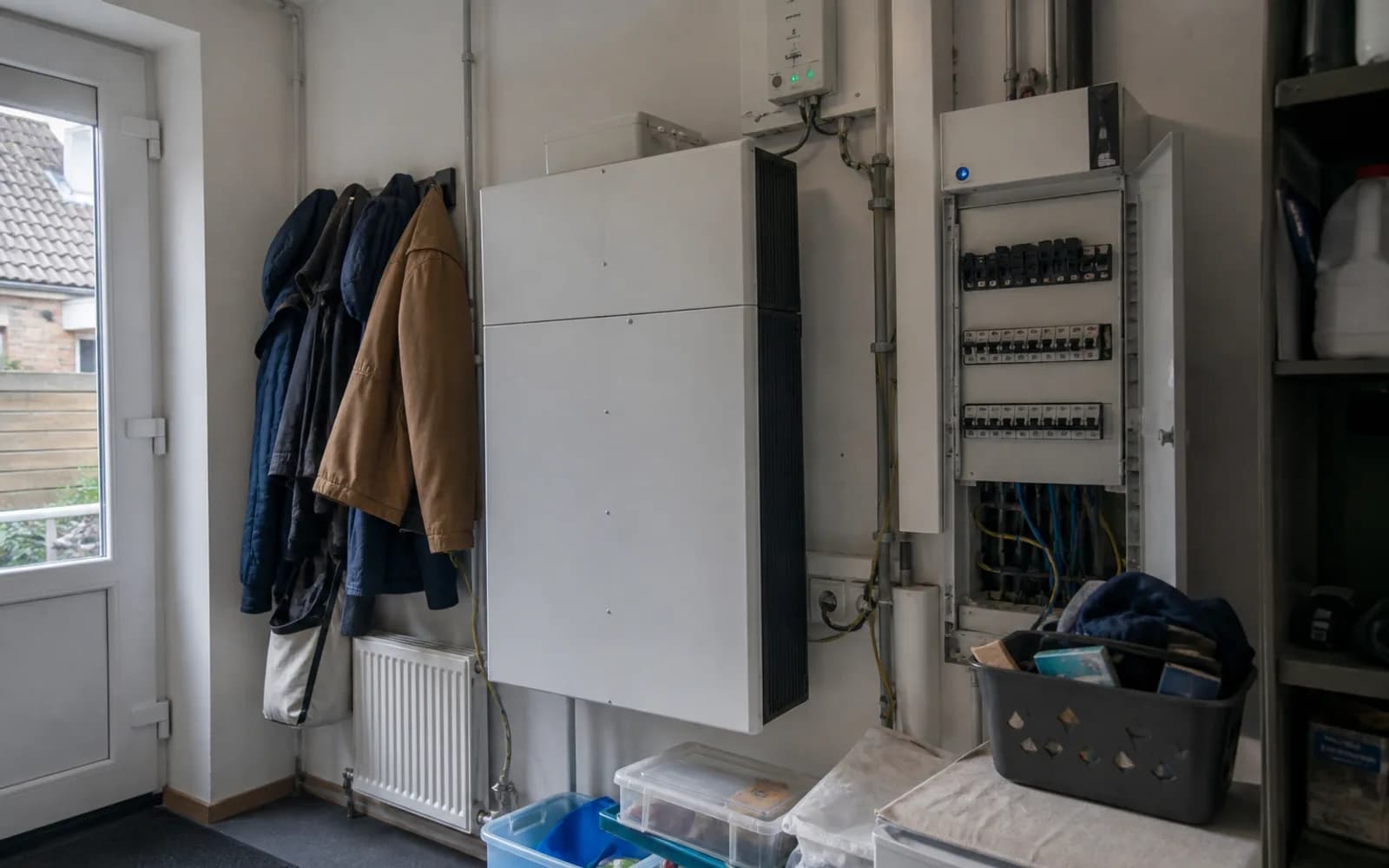
Usually within three weeks. Our installers fit the battery neatly and safely by your fuse box. We leave your home clean and make sure you know exactly how it all works.
- Charge smart when power is cheap
- Keep power until you need it
Frequently asked questions
Only from 1 January 2027, and only if your battery charges power from the grid and feeds it back. If you use stored power yourself, or charge from your own solar, you do not pay twice. Up to and including 2026 net metering offsets it.
Yes, for the part your battery charges from the grid and feeds back. Solar power that you store and use yourself or feed back is not taxed twice.
That is not settled. The cabinet is looking into whether it is technically possible and whether it is worth the extra complexity. Before the end of 2026 the House of Representatives hears how that research is going. A fix has not been promised.
Per kWh that you charge from the grid and feed back: 9.161 cents excluding VAT in 2026, and under the proposal 8.80 cents excluding VAT in 2027. What it comes to for you depends on how much grid power your battery feeds back.
If your battery trades: only let it feed back grid power when the price gap is larger than the energy tax and the losses. Ask your provider how the software weighs that.

Discover what smart energy can do for you
In about an hour you get insight into your savings, the options for your home and when the investment pays back. Straightforward, honest advice so you know exactly where you stand.
Smart energy at home
- Upgrade your home with our smart battery
- Solar panels matched to your roof and usage
- A heat pump to minimise your energy use
- Charge your electric car easily at home with an EV charger
Booking an advice call is easy
Fill in your details below. Within a day we will contact you to schedule a no-obligation advice call together.
Related articles